
Most travel blogs never get traffic. Not because the niche is too competitive, but because they follow the wrong strategy from day one. Here is the right one.
By Earning Hustler
Quick Answer
To get traffic to a travel blog with zero followers: Target low-competition specific keywords Google users actually search Build topical authority by writing multiple posts about one destination Publish Pinterest pins for every article immediately after posting Use Google Search Console to find and improve posts already ranking Interlink every new post to at least two existing articles None of these require any existing audience, social following, or paid ads. They work from the first article you publish.
Table of Contents
Why Do Most Travel Blogs Never Get Traffic?
Most travel blogs never get traffic. Not because the travel niche is too competitive, but because they publish the wrong type of content from the start. They write personal travel stories with titles like My Week in Bali or Top Things to Do in Bangkok. Nobody searches for those phrases. Getting traffic to a new blog requires writing about what people actively type into Google, not what the blogger wants to share.
A post titled My Week in Bali gets zero organic searches. A post titled How Much Does One Week in Bali Cost in 2026 gets searched thousands of times per month. The underlying travel experience can be identical. The title and the intent behind it determine whether Google sends anyone to that page. Most beginner travel bloggers learn this at month six or seven after publishing dozens of articles that generate nothing.
The other reason travel blogs stay stuck is publishing without a distribution system. Writing and publishing is only half the job. Every article needs to be submitted to Google Search Console for fast indexing, pinned on Pinterest for immediate traffic, and interlinked to other posts on the same blog to build site authority. Bloggers who skip these steps leave months of potential traffic on the table. If you are just starting, read our complete guide on how to start a travel blog and make money before applying the traffic methods below.
How to Grow a Travel Blog With Zero Followers
These five methods build travel blog traffic without any existing audience, social following, or advertising budget. They work from day one and compound over time as each new article and pin adds to your total traffic footprint.
Method 1: Build topical authority through keyword clusters
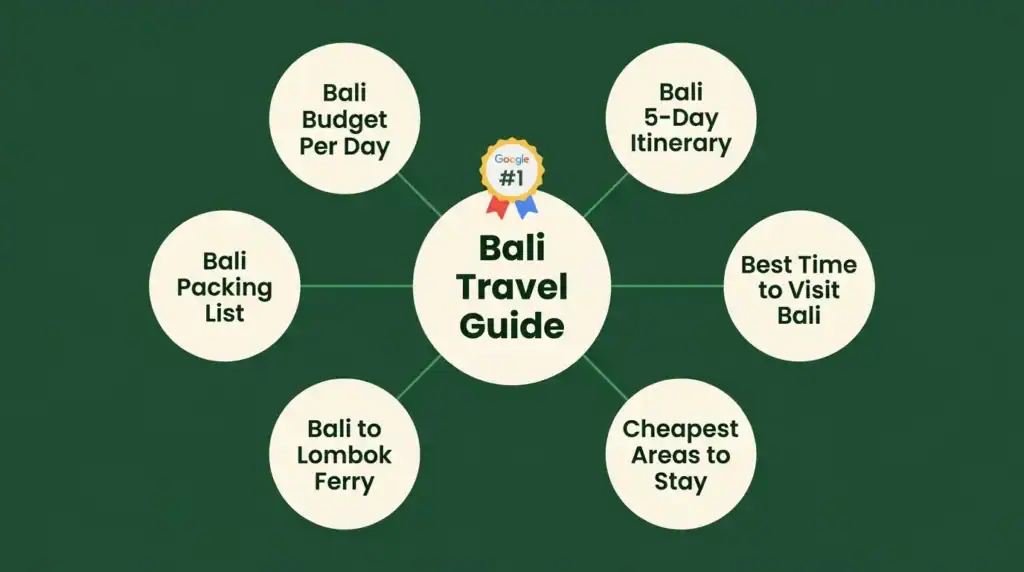
Topical authority is the most powerful way to grow a travel blog fast on Google and the strategy most beginners ignore. Instead of writing one post about each of twenty destinations, write ten posts about one destination. Google sees a blog with ten detailed posts about Bali as an authority on Bali travel and ranks multiple posts for Bali searches simultaneously.
Here is what a topical cluster looks like in practice. If your niche is Bali, your content cluster should include: Bali budget travel guide, Bali itinerary for five days, how much does a Bali trip cost, best time to visit Bali, cheapest areas to stay in Bali, and how to get from Bali to Lombok. Each of these is a specific search query with real monthly searches and low enough competition for a new blog to rank within two to four months.
A blog with one post about each of twenty destinations is seen as a generalist with no depth anywhere and ranks for nothing competitive. A blog with ten detailed posts about one destination has topical authority in that destination and ranks across multiple related searches. Build depth in one area first. Expand to new destinations only after your first cluster is published and indexed.
| Keyword targeting rule: if you cannot picture the exact person typing a phrase into Google and what they want to find, the keyword is too vague. How much does Bali cost per day for a backpacker is specific and searchable. Bali travel is not. |
Method 2: Pinterest for fast free travel blog traffic
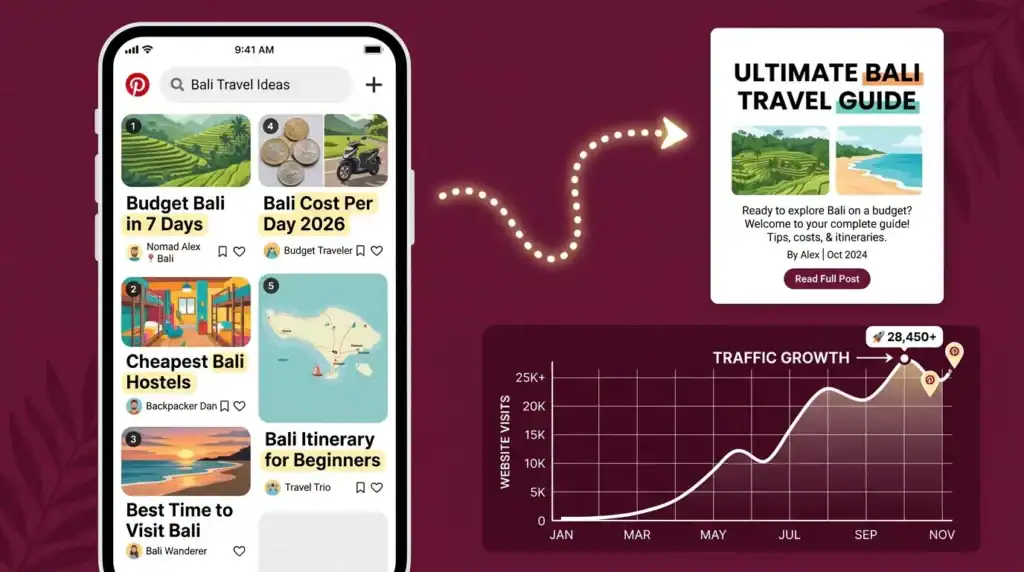
Pinterest is the fastest way to get traffic to a travel blog for free in the early months before Google rankings kick in. Pinterest works like a visual search engine. Users search for travel ideas and Pinterest surfaces pins matching their query. Unlike Instagram, Pinterest content has a long shelf life. A pin published today can drive consistent travel blog traffic tips for months or years without any further effort.
For every article you publish, create three to five Pinterest pins with different images and different title text. Link all pins to the article. Use specific keyword-rich descriptions: Best budget hostels in Bali for backpackers 2026 performs better than Beautiful Bali. Save pins to relevant boards with descriptive names. Southeast Asia Travel Budget. Bali Backpacking Tips. Indonesia Travel Guide.
New travel blogs consistently report Pinterest as their top traffic source in the first six months before Google rankings build. The combination of Pinterest for immediate traffic and Google SEO for long-term traffic is the standard growth approach for travel bloggers who reach 10,000 monthly page views within their first year. Use both from day one rather than choosing one over the other.
Method 3: Google Search Console quick wins
Google Search Console is a free tool that shows you exactly which searches your blog is appearing for and at what position. For a new travel blog, checking Search Console weekly reveals the fastest way to increase blog traffic: finding articles already appearing at positions 8 to 20 and improving them to move to positions 1 to 5.
When an article appears in searches but gets no clicks it usually means the title needs improving, the article needs more specific detail, or it is missing a keyword the searcher used. All three are fixable in one to two hours of editing. A post at position 11 can reach position 3 with targeted improvements in two to four weeks. A new article takes three to six months to reach the same position from zero. Improving existing content is the fastest travel blog traffic tip available to any blogger with posts already indexed.
Submit every new article to Search Console using the URL Inspection tool immediately after publishing. This requests indexing and can cut the time from publishing to appearing in Google searches from weeks to days. Most beginner bloggers skip this step and wonder why their new articles are not showing up in search results for the first month.
Method 4: Internal linking to build site authority
Internal linking is one of the most effective travel blog traffic tips and the most underused by beginners. Every new article should link to at least two existing posts using descriptive anchor text. Not click here or read more. Specific anchor text like the full Bali five-day itinerary or how much Bali costs per day reinforces the keyword relevance of the linked page.
A blog where every article is an isolated island with no links to other posts on the same site grows much slower than one where every article links to two or three related posts. For a travel blog built around topical clusters, internal linking is especially powerful because it signals to Google that your Bali budget posts, your Bali itinerary posts, and your Bali accommodation posts are all part of the same coherent content network about the same destination.
Update existing articles every time you publish a new related post. Go back to your Bali budget guide and add a link to the new Bali five-day itinerary post. Go back to the itinerary post and add a link to the accommodation guide. This network of links builds faster than publishing new content alone because it improves every existing page simultaneously.
Method 5: Instagram for travel blog traffic
Instagram drives travel blog traffic differently from Google and Pinterest. It builds an audience of people who follow your content and click through to your blog when you direct them there. It is a supporting traffic channel, not a primary one for a new blog.
The most effective Instagram approach for driving blog traffic is to repurpose existing articles as Instagram carousel posts. A five-slide carousel summarising the top five budget hostels in Bali with a link to the full article in your bio consistently generates more blog click-throughs than a standard travel photo. Use Instagram to extend the reach of content you have already written rather than creating separate Instagram-native content.
Prioritise Google SEO and Pinterest first. Add Instagram as a third channel once you have a consistent publishing rhythm. Trying to maintain all three channels from article one leads to burnout and lower quality across all of them.
How to Increase Travel Blog Traffic Fast Without Paying for Ads
The fastest combination for increasing travel blog traffic without paid ads is Search Console optimisation of existing articles plus Pinterest distribution of new ones. Search Console improvements move existing articles from page two to page one faster than any other method. Pinterest delivers traffic to new articles within days of publishing.
On week one: submit every existing article to Search Console for indexing. Create three Pinterest pins for every article already published. On week two: check Search Console and improve any article appearing at positions 8 to 20. On week three: publish two new articles targeting specific low-competition keywords. Create Pinterest pins for both immediately.
Repeat this cycle every two weeks. By week eight you will have 16 published articles, 48 Pinterest pins, and a clear picture from Search Console of which posts are gaining traction. This is when you double down on the posts showing early signals and build topical cluster content around them.
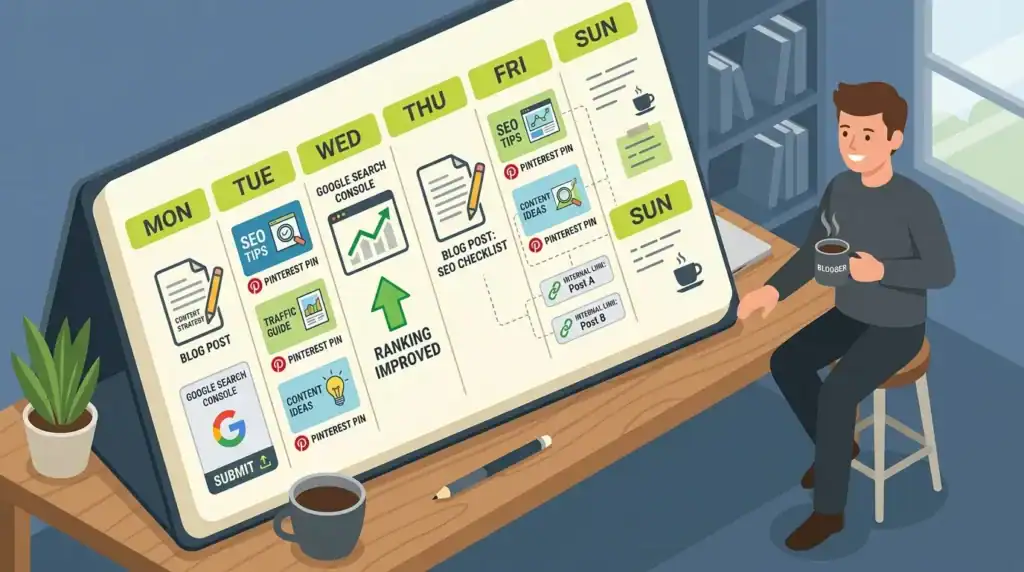
The Simple Weekly System for Travel Blog Traffic Tips
Monday: Publish one new article targeting a specific low-competition keyword. Submit to Google Search Console immediately. Tuesday: Create 3 Pinterest pins for the new article with different images and titles. Publish to relevant boards. Wednesday: Check Google Search Console. Find any article at positions 8 to 20. Improve the title and add more specific content. Thursday: Publish second new article. Interlink it to two existing posts with descriptive anchor text. Friday: Create 3 Pinterest pins for the second article. Update two older articles to link to the new ones. Do this for 8 weeks. By week 8: 16 articles, 48 Pinterest pins, and real Search Console data showing what is working.
What Mistakes Keep Travel Blogs Stuck at Zero Traffic?
Publishing without submitting to Google Search Console
A published article is not automatically indexed by Google. Submitting every new article through the URL Inspection tool in Google Search Console requests indexing immediately and can cut the time from publishing to appearing in search results from weeks to days. Bloggers who skip this step wait unnecessarily long to see any Google traffic from new content.
Targeting broad keywords a new blog cannot rank for
Best places in Europe and things to do in Thailand are owned by sites with millions of backlinks. Every article on a new travel blog should target a specific long-tail query: cheapest hostels in Chiang Mai for solo travelers or how many days to spend in Lisbon on a first visit. These specific queries have real search volume and low enough competition for a new site to rank within two to four months of publishing.
Writing every article without interlinking to existing posts
Every new article you publish without linking to existing posts is a missed opportunity to build site authority. Every article you publish without updating existing posts to link back to it is another missed opportunity. Internal linking builds the authority network that helps Google understand and rank your content cluster. Without it, every post starts from zero authority regardless of how long you have been publishing.
About Earning Hustler
| Earning Hustler covers practical traffic and income building strategies for bloggers, freelancers, and digital content creators. Everything published here is based on real methods with real numbers. |
Related Articles
- How to Start a Travel Blog and Make Money in 2026
- 7 Tips to Earn Money Online Through Travel Blogging
- How to Get Your First Web Design Client With No Portfolio – Earning Hustler
Frequently Asked Questions
How do I get traffic to a travel blog with zero followers?
Get traffic to a travel blog with zero followers by targeting specific low-competition search queries that real travelers type into Google, building topical authority by writing multiple posts about the same destination, publishing Pinterest pins for every article immediately after posting, submitting every article to Google Search Console for fast indexing, and interlinking every new post to at least two existing ones. These methods work without any existing audience, social following, or paid promotion.
How do I get traffic to a travel blog for free?
The two best free traffic sources for a travel blog are Google organic search and Pinterest. Google delivers consistent long-term traffic to articles that rank for specific travel queries. Pinterest delivers faster initial traffic because pins appear in search results within days of publishing. Use both simultaneously by publishing SEO-targeted articles and creating three to five Pinterest pins for each one immediately after posting.
How long does it take to get traffic to a travel blog?
Pinterest traffic can start within days of publishing your first pins. Google organic traffic typically takes two to four months for specific low-competition keywords on a new blog. Travel blogs that publish two articles per week, create Pinterest pins for every article, and improve existing content using Google Search Console data consistently see meaningful traffic growth within four to six months of starting.
How do I promote a travel blog without social media followers?
Promote a travel blog without social media followers by focusing on Google SEO and Pinterest, both of which deliver traffic based on content quality and keyword relevance rather than social proof. A new travel blog with zero followers can rank on Google and appear in Pinterest search results from the first day of publishing if the content targets the right queries with specific intent. Followers are not required for either platform to work.
What is topical authority and how does it help a travel blog?
Topical authority means being seen by Google as an expert on a specific subject because you have multiple detailed posts covering different aspects of the same topic. For a travel blog, building topical authority means writing ten posts about Bali rather than one post each about ten different destinations. Google ranks blogs with topical authority higher for searches related to that topic because the depth of coverage signals genuine expertise. It is the most effective long-term strategy for growing a new travel blog without backlinks.